


AI Agents & Automation
Build the knowledge foundation, AI agents, and connected automations that support and execute repeatable work across your business, from ecommerce operations and customer service to sales, HR, admin, billing, and reporting, with clear permissions, human approvals, and accountable ownership.
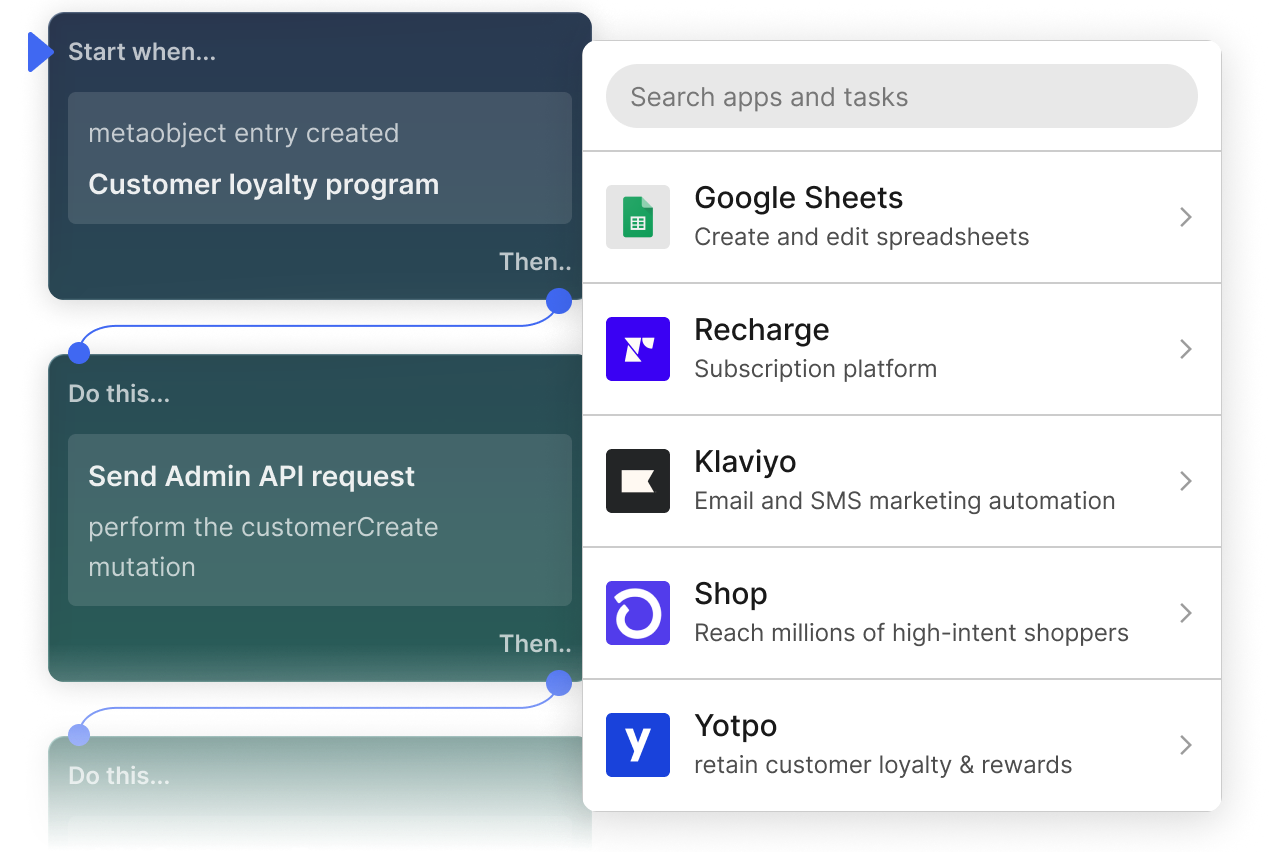
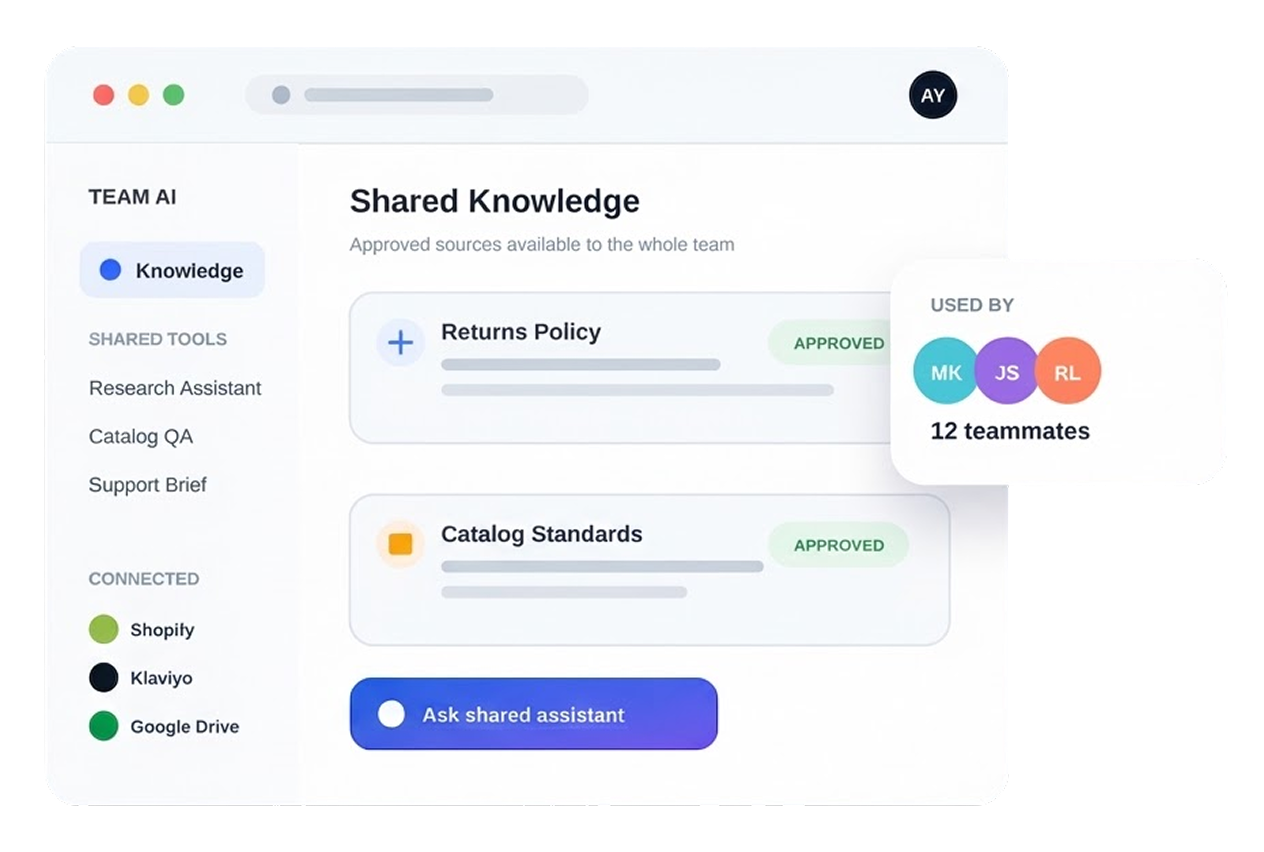
Automate the Work Behind the Store
An ecommerce business runs on much more than its storefront. Orders, customers, people, projects, invoices, documents, reports, approvals, and internal requests all create recurring work behind the scenes.
Always Open Commerce builds AI agents and automations around those business processes, not just traditional ecommerce tasks. We can help organize the knowledge those systems need, connect information across applications, reduce unnecessary manual work, and give teams better operational support while keeping people responsible for decisions that require judgment.
Business Processes AI Agents & Automation Can Support
The service can support recurring work across ecommerce and the wider business when the workflow, permissions, systems, and human ownership are clear.

Ecommerce & Operations
Connect product, order, inventory, fulfillment, platform, and operational workflows where repeatable steps can move between systems with fewer manual handoffs.

Sales & CRM
Capture and route leads, prepare account context, update records, support follow-up, and coordinate handoffs while your team retains ownership of qualification, pricing, commitments, and relationship decisions.

Customer Support
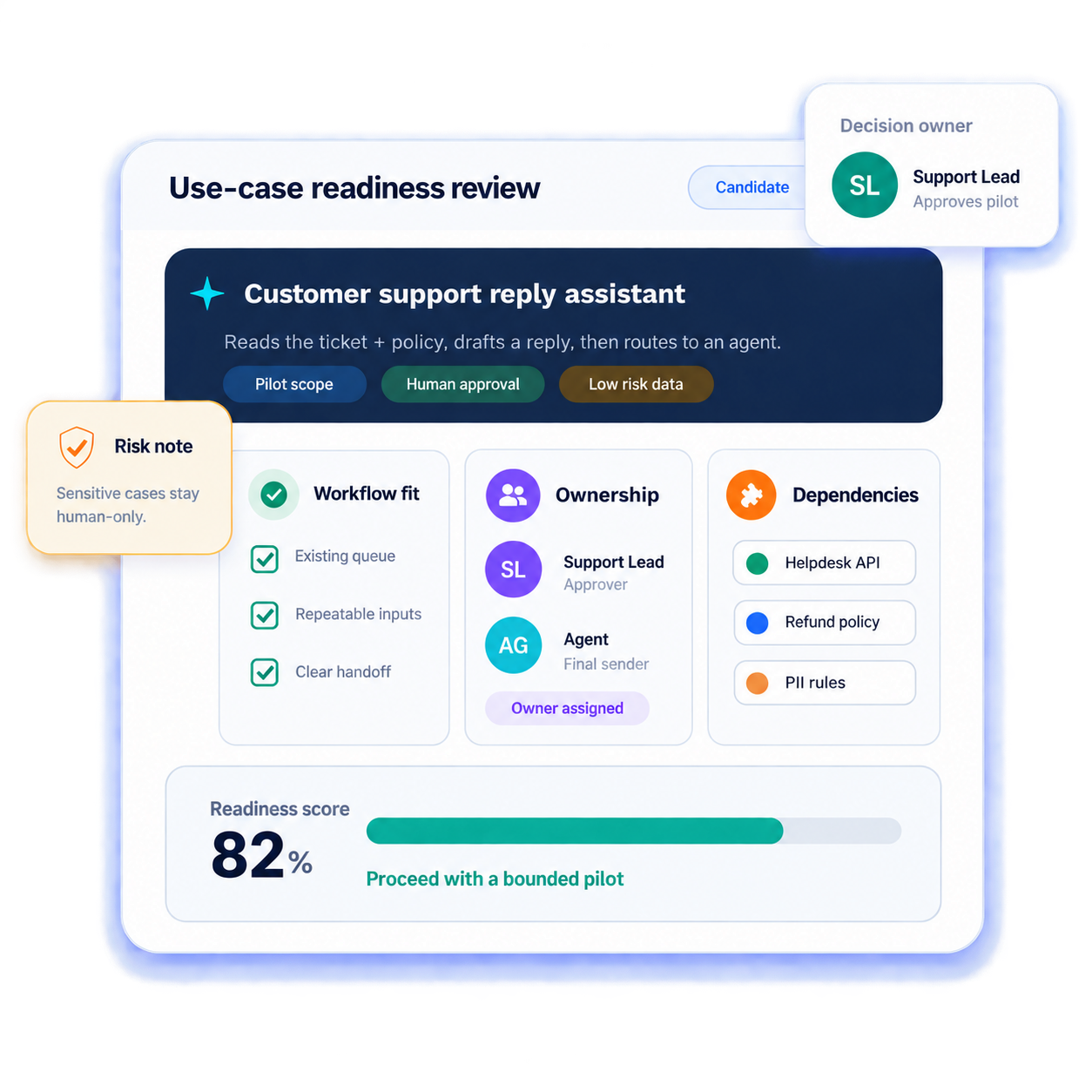
Triage incoming requests, retrieve approved company knowledge, prepare responses, route exceptions, and keep support information synchronized across connected tools.

Marketing & Content
Move research, briefs, drafts, approvals, asset requests, campaign tasks, and status updates through repeatable workflows while keeping strategy, creative judgment, and public claims human-owned.

HR & People Operations
Support onboarding and offboarding administration, document collection, employee requests, reminders, and internal workflows without handing hiring, performance, compensation, disciplinary, or other consequential employment decisions to an agent.
Admin & Project Management
Create and route tasks, collect information, organize documents, prepare meeting follow-ups, track approvals, and keep recurring administrative work moving between people and systems.

Billing & Finance Operations
Prepare billing reviews, invoice inputs, reminders, record updates, and reconciliation workflows for human review. Payments, financial approvals, and other consequential financial actions remain behind appropriate controls.

Reporting & Data
Collect information from approved systems, normalize recurring inputs, prepare summaries, distribute reports, and flag exceptions that need someone to investigate.
Build the Knowledge Foundation Before the Automation
Useful AI agents need more than access to an AI model. They need access to the right company knowledge, business rules, documents, systems, and context. That starts with creating a dependable knowledge foundation the AI can retrieve from and use while completing work.

Retrieval-Augmented Generation (RAG)
RAG gives AI agents access to approved company knowledge such as SOPs, policies, product information, internal processes, FAQs, templates, and business rules. Always Open Commerce can help organize those sources, identify what is authoritative, and connect that knowledge to AI systems while keeping existing business systems as the source of truth for the records they own.
AI Agents
AI agents use company knowledge and connected systems to handle work that requires interpretation, research, classification, summarization, preparation, or context-aware routing. They can support customer service, sales, HR administration, billing preparation, operations, reporting, project management, and ecommerce workflows, with clear permissions and boundaries around what they can do.
AI Automations
AI automations connect agents, applications, triggers, data, rules, and business systems into repeatable workflows. Some steps may use AI reasoning, while others should remain predictable and rules-based. Always Open Commerce can use platforms such as Make.com to orchestrate these workflows across connected applications while choosing the technology and level of automation based on the business process.
Human Checkpoints
AI agents and automations should have clear limits. High-impact, sensitive, or difficult-to-reverse actions should retain appropriate human review rather than being handled autonomously. Human checkpoints can also handle low-confidence results, exceptions, or missing information. The goal is effective automation with accountable human decision-making, not maximum autonomy.
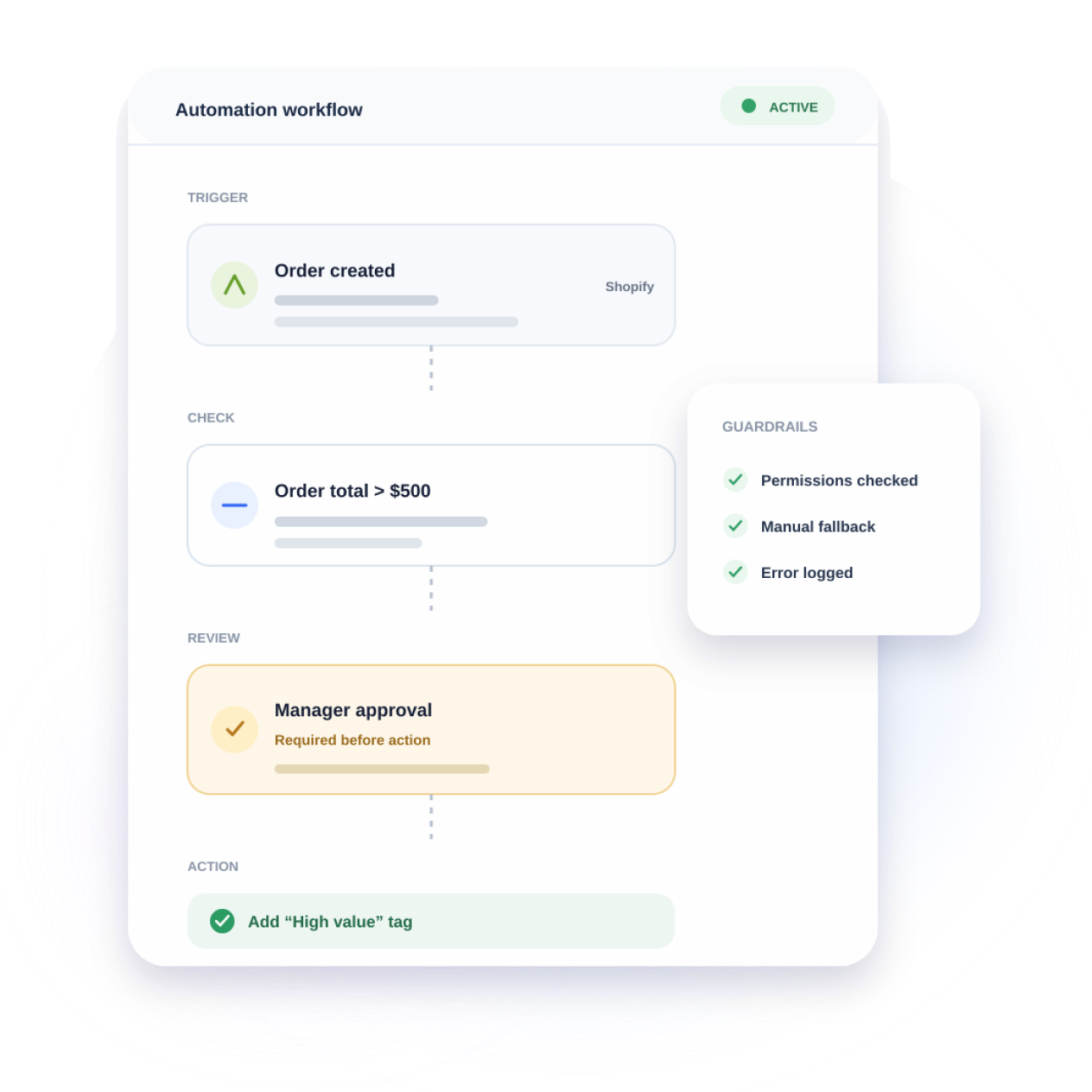
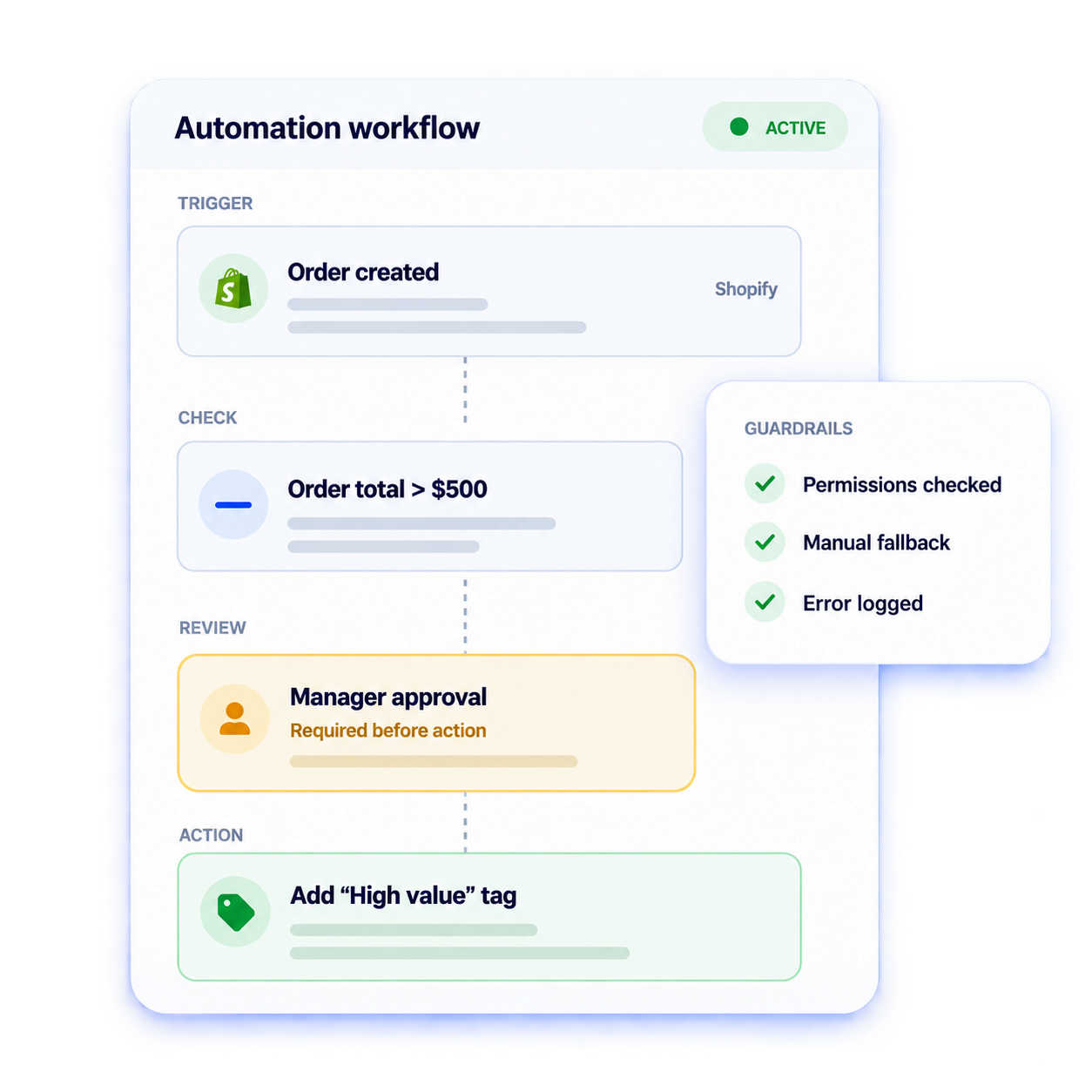
Start With the Business Process, Then Build the Right System
Good automation begins with understanding the business problem, not selecting an AI tool.

Define the Outcome
Identify the repetitive work, bottleneck, handoff, or operating problem the business wants to improve. Clarify what a successful workflow should accomplish and which people or systems depend on the result.

Organize the Knowledge
Identify the SOPs, policies, business rules, shared files, systems, templates, and other approved sources the agent needs to understand the business and complete the workflow. Determine which sources are authoritative, what information should remain in existing business systems, and what knowledge the agent needs to retrieve during execution.

Map the Workflow
Document the trigger, inputs, decisions, exceptions, approvals, systems, outputs, and people involved. This helps separate predictable execution from the parts of the process that actually require interpretation or judgment.

Choose the Right Execution Model
Determine which steps should remain manual, which should use deterministic automation, and where an AI agent can add useful interpretation, reasoning, or retrieval. Not every workflow needs an agent, and not every agent needs permission to take action.

Build and Test
Connect the required systems, configure the workflow, test normal and material edge cases, confirm permissions, validate retrieved knowledge, and determine what happens when something fails, repeats, or produces an exception.

Launch With Ownership
Production automations need an owner, monitoring, documented operating rules, failure handling, and a clear path for updates as business processes, applications, APIs, AI models, and company knowledge change. Starting with one useful workflow is often better than trying to automate an entire company at once. Once a process works reliably, connected agents and automations can expand around other business needs.
Build Automation the Business Can Actually Operate
An automation is not finished because it successfully ran once. Reliable business automation needs enough structure around it that the team understands what it does, what systems it can access, which information it trusts, what happens when something goes wrong, and who is responsible for maintaining it.
Clear Sources of Truth
Business rules, policies, customer records, employee information, financial records, and other authoritative data should remain in the systems that own them. Agents and automations should use those systems rather than becoming undocumented sources of truth themselves.

Controlled Knowledge Access
The company brain should not mean that every agent can see everything. Knowledge retrieval should be designed around the information the workflow actually needs, with appropriate boundaries for company, client, personal, financial, HR, authentication, and other sensitive information.

Controlled System Access
Connections and permissions should give each workflow only the access required for its job. Sensitive information, credentials, HR data, financial information, restricted client data, and actions that affect access or external systems require additional review.

Failure and Duplicate Protection
Workflows that send messages, create records, issue invoices, change access, or take other difficult-to-reverse actions should account for errors, retries, duplicate runs, and incomplete execution. A failed automation should not silently become a second invoice, duplicate customer message, repeated task, or unintended system change.
Monitoring and Maintenance
Applications, APIs, AI models, business rules, and company processes change. Production workflows need monitoring, ownership, documentation, and periodic review so they remain useful after launch.
Built From the Same Operating Principles We Use Internally
Always Open Commerce is a Free-Agency™ built for the AI era. Our internal automation model separates durable business knowledge, repeatable automation, and AI-assisted reasoning rather than forcing every problem into the same tool.
Authoritative systems hold the business information. Shared company knowledge provides approved context. Automation handles predictable execution. AI agents are introduced where retrieval, interpretation, research, classification, or other context-aware work adds value. People remain accountable for consequential decisions.
Client systems are not copies of our internal environment. Each implementation should be designed around the client’s people, applications, information, source systems, security requirements, operating processes, and risk.
That combination of company knowledge, RAG, AI agents, connected systems, automation, governance, and human accountability is what AI Agents & Automation is designed to deliver.
Related AI Commerce Services

Turn scattered AI requests and use cases into clearer priorities, ownership, governance, and an adoption plan before implementation begins.

Establish a stronger baseline when the primary question is diagnostic and the team needs to understand what is ready, missing, or worth pursuing.

Replace selected apps or fragmented workflows with a purpose-built commerce system that can combine native capabilities, integrations, automation, custom development, and AI where appropriate.
AI Agents & Automation FAQs
The service can address workflows across ecommerce operations, sales, CRM, customer support, marketing, HR administration, project management, billing operations, reporting, company knowledge, and other recurring business processes. The right starting point depends on the workflow, systems, information, permissions, exceptions, and business impact involved.
Agents that need company-specific knowledge require a dependable way to access that information. The exact architecture can vary. Some businesses already have well-organized documentation and source systems. Others need substantial knowledge cleanup and organization before an agent can use that information effectively. The important part is establishing what information the agent should trust and how it can retrieve that information during the workflow.
Yes. AI Agents & Automation is specifically intended to support the wider business behind an ecommerce operation. That can include HR administration, billing workflows, sales processes, internal operations, project management, reporting, customer support, and other business functions in addition to ecommerce workflows. Always Open Commerce remains focused on ecommerce businesses, but the automation opportunity does not have to stop at the storefront.
Retrieval-Augmented Generation, or RAG, gives an AI system access to approved external knowledge when it needs to answer a question or complete a task. For a business, that can mean connecting agents to relevant SOPs, policies, documentation, templates, FAQs, service information, training material, and other controlled company knowledge. Instead of expecting the AI model to already know the business, RAG gives it a way to retrieve the relevant context from approved sources.
An AI agent handles work that benefits from interpretation, natural language, retrieval, research, classification, summarization, reasoning, or context-aware decisions within defined boundaries. An AI automation connects agents and traditional workflow logic to triggers, applications, records, data transformations, routing, notifications, and other business actions. Many useful systems combine both. An agent handles the context-dependent step while automation handles predictable execution before and after it.
Yes. Make.com can be used as an orchestration platform for connecting applications, moving information, triggering workflows, routing work, transforming data, and coordinating AI-enabled steps. The exact architecture depends on the client’s current systems and the workflow being automated. Make.com does not need to be the right platform for every process.
More Questions
They can when the use case, system access, integration method, permissions, data handling, and risk support it. Agents should operate within clearly defined boundaries. Higher-impact actions may require validation, an approval step, or a human decision before the workflow continues.
AI Consulting & Enablement helps determine where AI belongs, which opportunities deserve priority, how AI should fit into the business, and what should be implemented. AI Agents & Automation is the primary implementation service within AI Commerce for building the knowledge foundation, agents, automations, connected workflows, and operational systems behind those opportunities.
Custom Commerce Systems focuses on purpose-built ecommerce systems and consolidating or replacing selected commerce applications and fragmented functionality. AI Agents & Automation focuses on connecting knowledge, AI agents, workflows, and existing business applications so work can move across the organization more effectively.
Potentially, yes. Existing documentation can form part of the knowledge foundation when it is appropriate for the use case and access model. The work may include organizing source files, identifying authoritative documents, improving structure, and connecting approved information to the retrieval system used by the agent. The architecture should be designed around the client’s actual knowledge sources rather than assuming every document belongs in one repository.
Agentic Commerce focuses on customer-facing AI shopping and commerce experiences. AI Agents & Automation focuses primarily on the internal and operational workflows that help the business itself work more effectively.

 USA
USA
 Philippines


