

















































SEO
Organic search works best when the products, categories, and content with the strongest commercial opportunity are easy to discover and understand. Always Open Commerce turns search demand, technical conditions, and storefront priorities into a focused ecommerce SEO plan.


Start With Commercial Search Demand
Ecommerce SEO should start with the searches that matter to the business, not with a long list of isolated fixes. The first question is where qualified organic discovery can support the products, categories, services, or information the business most needs people to find.
That means connecting search demand to the actual storefront. Search intent, current visibility, site structure, content quality, and technical conditions all influence whether the right page can compete for the right need. The goal is a clearer hierarchy of opportunities, not more SEO activity for its own sake.
Research, Technical SEO, Content & Site Structure
Always Open Commerce combines search research with ecommerce context so priorities reflect how the store sells, merchandises, and maintains its content.

Search Demand & Intent Research
Identify commercially relevant searches and buyer questions, then map them to the products, categories, services, and supporting content that should answer them. Competitive search data can help reveal gaps and patterns, but the roadmap stays centered on the business and its customers.

Technical SEO & Indexing
Review crawlability, indexing, canonicalization, URL patterns, rendering, and other technical conditions that can limit or fragment organic visibility. When the solution requires code, template, platform, or infrastructure changes, the appropriate technical specialist confirms the implementation.

Product, Category & Page Optimization
Improve important destinations through clearer targeting, useful page content, metadata, hierarchy, and internal relationships. The objective is to make each page more useful and easier for search engines to understand, not to add copy simply to satisfy a keyword target.

Content & Internal Linking
Align headings, supporting copy, metadata, and internal links with the role each page needs to play. When substantial new or revised copy is required, Content Writing & Strategy can carry the approved SEO direction into the content.

Measurement & Prioritization
Use available search-performance and site data to understand where visibility is changing and which opportunities deserve attention. Reporting should lead to decisions about what to investigate, improve, or monitor next rather than become the strategy itself.
Prioritize the Highest-Value SEO Work
Not every SEO finding should receive the same investment. The right sequence depends on commercial value, search opportunity, technical risk, effort, and what the business can realistically maintain.

Where Is the Strongest Search Opportunity?
Prioritize the products, categories, services, and questions where improved visibility can support meaningful discovery. A large keyword list is useful research input, but it is not a business priority list.
Does Each Page Have a Clear Search Role?
When several URLs compete for the same intent or important pages are difficult to reach, targeting becomes harder for both shoppers and search engines to interpret. Clarify page purpose, hierarchy, and internal relationships before expanding the content footprint.
Are Major Site Changes Creating Search Risk?
Migrations, redesigns, platform changes, URL changes, and other structural updates can affect crawlability, indexing, and existing visibility. SEO Migration should own launch-specific preservation when the site itself is moving or being substantially rebuilt.
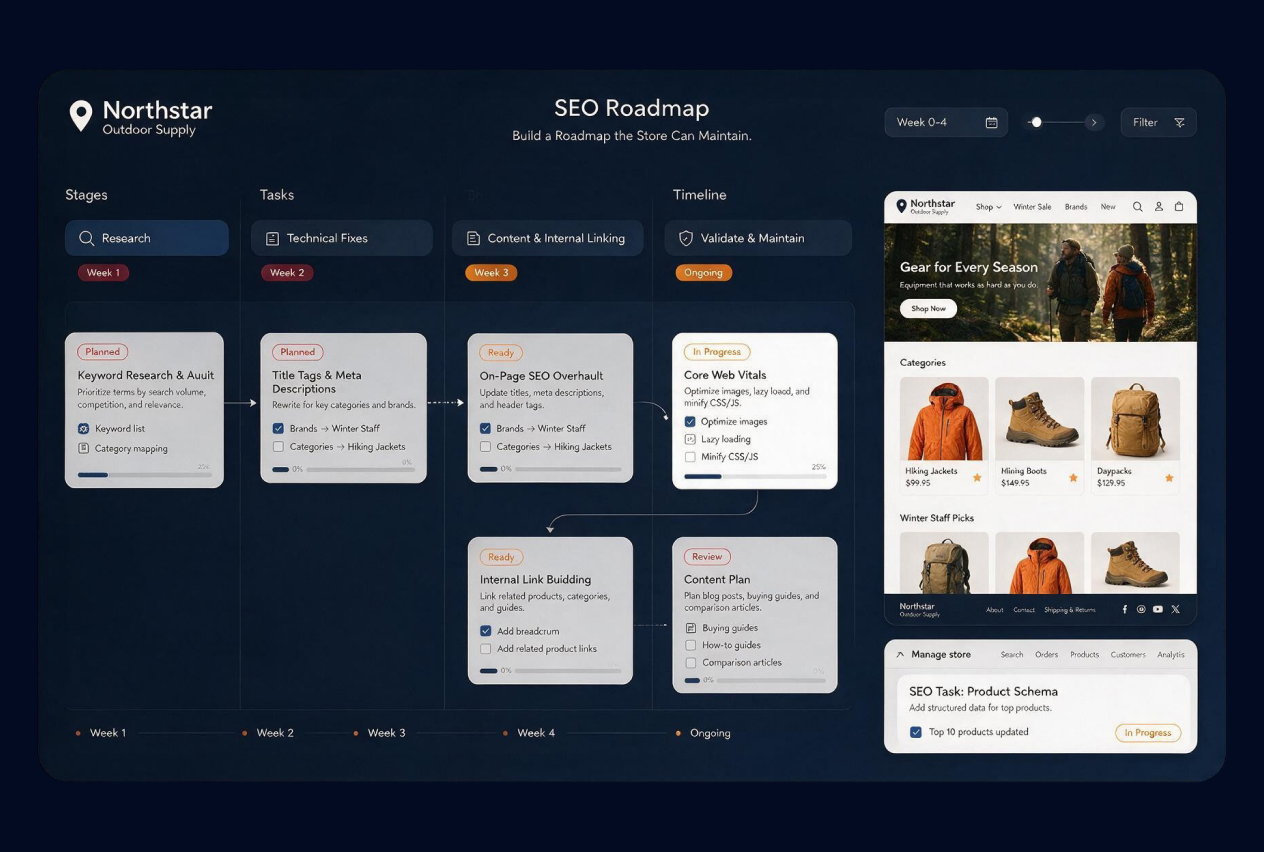
Build a Roadmap the Store Can Maintain
A useful SEO program turns research and technical findings into a manageable sequence of work. Some priorities may stay within SEO, while others belong with content, Structured Data, storefront development, migration planning, or another specialist service.
Always Open Commerce coordinates those dependencies so the search requirement is clear before adjacent work begins. SEO remains focused on qualified organic discovery in traditional search. AI Search & GEO addresses the related but different question of how brand and product information is retrieved, interpreted, cited, or surfaced in AI-assisted discovery.
Organic Search in Practice

Related Search Services


Frequently Asked Questions
Depending on the opportunity, SEO can include search-intent research, technical SEO direction, page and catalog optimization, metadata, content recommendations, internal linking, search-performance review, and prioritization. The exact mix follows the site’s search needs rather than a fixed checklist.
SEO focuses on traditional organic search demand, crawlability, indexing, content, site structure, and visibility. AI Search & GEO focuses on how brand and product information can be retrieved, interpreted, cited, or surfaced in AI-assisted search and answer experiences. The foundations overlap, but the discovery problem is different.
Yes. Findings involving rendering, URL handling, canonicals, templates, crawlability, or other technical conditions may require development. SEO defines the search requirement and priority; the appropriate technical specialist confirms feasibility and implementation.
No. Search engines control crawling, indexing, ranking, and result presentation, and outcomes depend on factors outside any agency’s control. Always Open Commerce does not guarantee rankings, traffic increases, or revenue outcomes.

 USA
USA
 Philippines


