




















































PIM Setup & Support
Product information becomes harder to manage when teams and systems rely on different structures or sources. A PIM creates a clearer foundation, and Always Open Commerce helps define the data model, workflows, and commerce connections needed to support it.


When Product Information Gets Hard to Control
Product data often grows across spreadsheets, ERP exports, supplier files, ecommerce fields, images, and team-specific workarounds. The problem is not only whether the information exists. It is whether the right attributes, variants, descriptions, assets, and channel requirements are organized consistently enough to maintain and reuse.
Always Open Commerce supports PIM setup and product-data workflows around approved ecommerce requirements, including data structure, catalog organization, product-information workflows, and commerce connections. Enterprise data governance and full manual cleanup of legacy records remain separate unless specifically scoped.
Structure, Enrichment & Distribution
The work depends on catalog complexity, source systems, channel requirements, and the selected PIM or product-data environment.

Product Data Model
PIM Setup & Support
Define the attributes, specifications, categories, and other product information that must be managed consistently across the catalog.

Products, Variants & Relationships
PIM Setup & Support
Organize parent products, variants, options, and related structures so product information can be maintained without unnecessary duplication.

Enrichment & Review Workflows
PIM Setup & Support
Support defined completion, enrichment, review, or approval workflows when the selected PIM and project scope include them.

Channel Requirements
PIM Setup & Support
Map which fields or content are needed for ecommerce, marketplaces, shopping feeds, or other approved destinations.

Commerce Connections
PIM Setup & Support
Coordinate the product-data connection between the PIM and ecommerce environment when API Integrations or another supported data flow is in scope.
Decide What Belongs Where
The key decisions are where product information originates, which fields belong in the PIM, who owns updates, how data reaches ecommerce, and how much cleanup is needed.

Where Is the Source of Truth?
Identify whether product information originates with suppliers, an ERP, internal teams, ecommerce, or another system before deciding what should enter the PIM.
Which Fields Belong in the PIM?
Separate core product attributes from channel-specific content, operational values, optional enrichment, and information that should remain elsewhere.
Who Owns Updates and Review?
Clarify who creates, enriches, reviews, and approves product information so the new system does not preserve unclear ownership.
How Will Data Reach Ecommerce?
Define the expected data flow between the PIM and storefront, including an approved API, connector, import, or other integration method.
How Much Cleanup Is in Scope?
PIM setup can improve structure, but full correction of legacy records is not automatic. Identify data quality and cleanup needs before implementation is treated as complete.

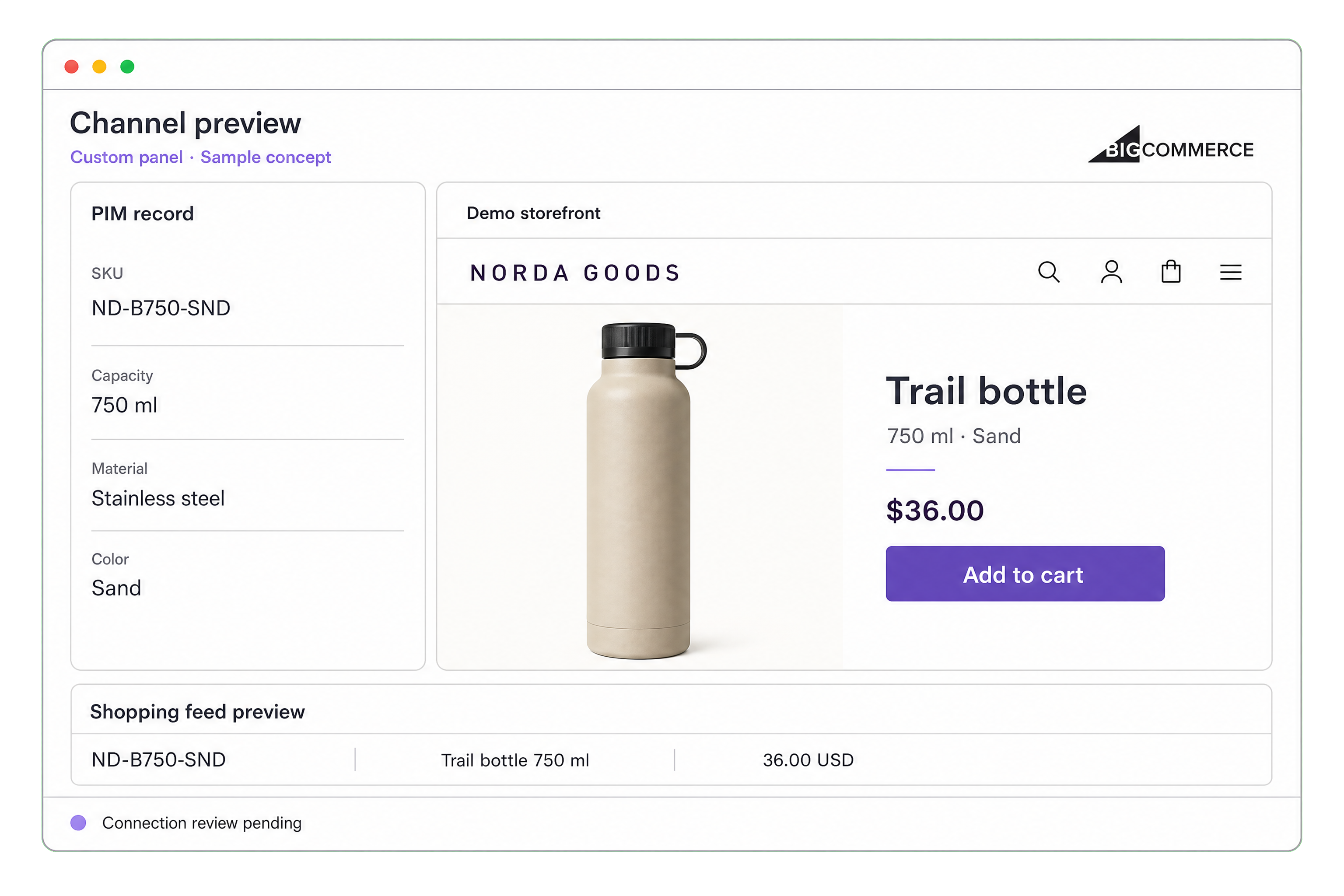
Build a Catalog That Works Across Channels
A useful PIM foundation makes product information easier to structure, maintain, enrich, and distribute so teams are not rebuilding the same catalog logic for every channel or assortment.
Related work may include API Integrations, Shopping Feeds, Marketplace Setup, or Data/Catalog Migration when product data also needs to move across systems or channels. The selected PIM controls its own features and workflow capabilities. Enterprise data governance and full legacy-data cleanup are not included by default.
Product Data in Practice

Related Technologies


Frequently Asked Questions
It can include product-data structure, catalog workflows, PIM setup support, and connections between product information and ecommerce operations within the approved scope.
A PIM is generally used to organize and enrich product information for channels and customer-facing experiences, while an ERP typically owns operational information such as inventory, purchasing, finance, or order processes. The exact system responsibilities depend on the client environment.
Not always. A PIM becomes more relevant when product information is complex, managed across multiple systems or teams, or needs to support several channels and repeatable enrichment workflows.
Not automatically. Data cleanup can be scoped, but manual correction of every legacy product record is outside the standard service boundary unless specifically approved.
Often, but the available connection depends on the selected PIM, ecommerce platform, API or connector options, data model, and technical requirements. Integration feasibility requires technical review.
No. Full enterprise data-governance programs, organization-wide master-data policy, and ownership frameworks beyond the ecommerce project are separate unless specifically scoped.

 USA
USA
 Philippines


