






















































Model Context Protocol (MCP)
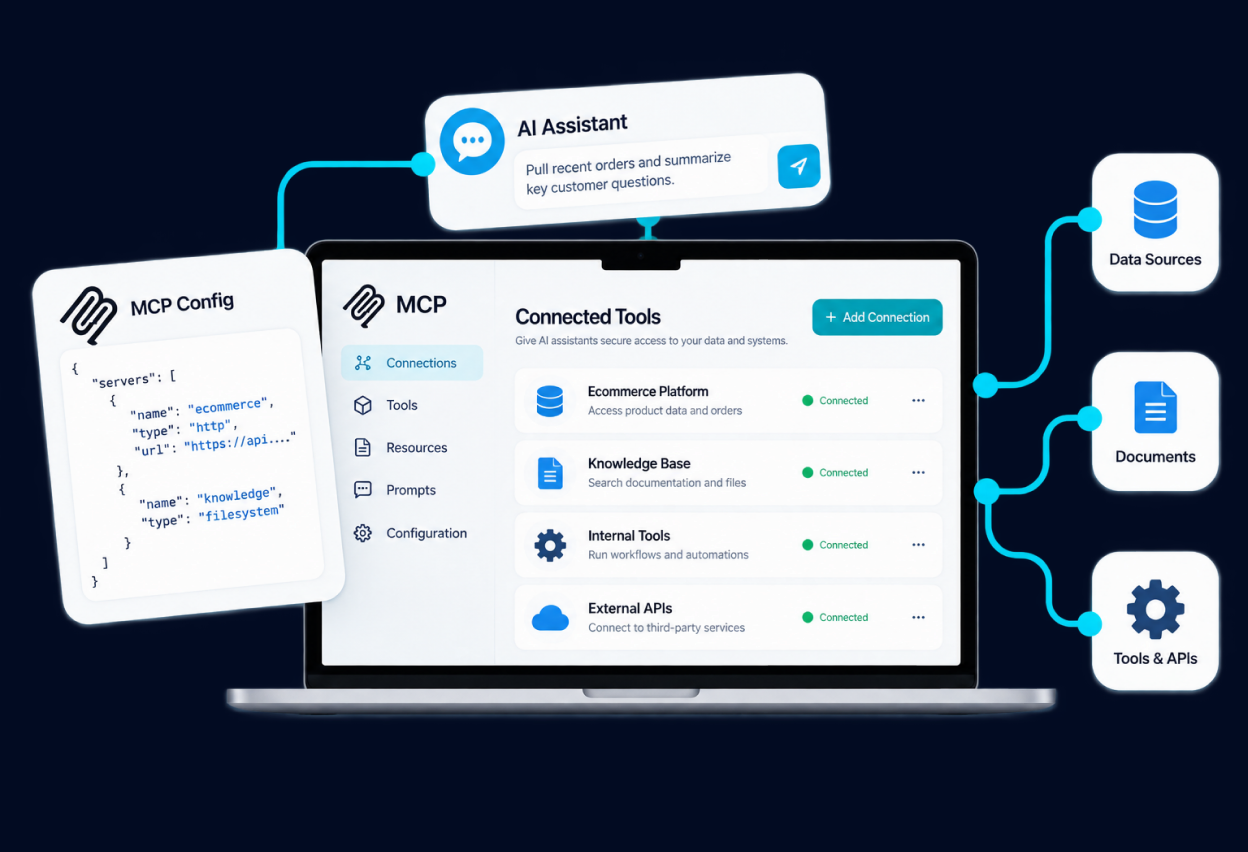
Model Context Protocol (MCP) gives compatible AI systems a standard way to discover and use external tools, resources, and prompts. Always Open Commerce helps ecommerce teams decide where MCP belongs, expose only the capabilities a workflow needs, and pair the connection with identity, permissions, validation, and human review.
Choose MCP When Shared AI Access Matters More Than a One-Off Connector
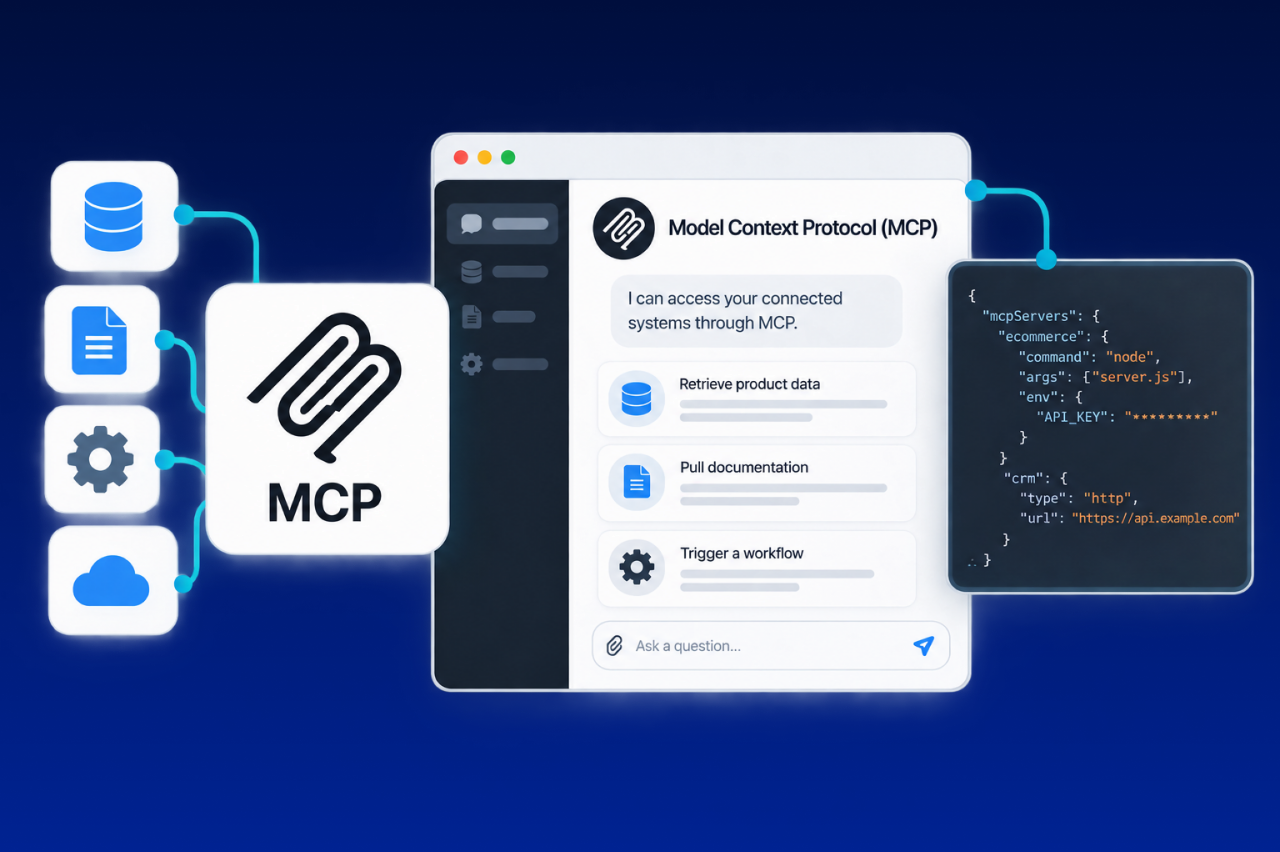
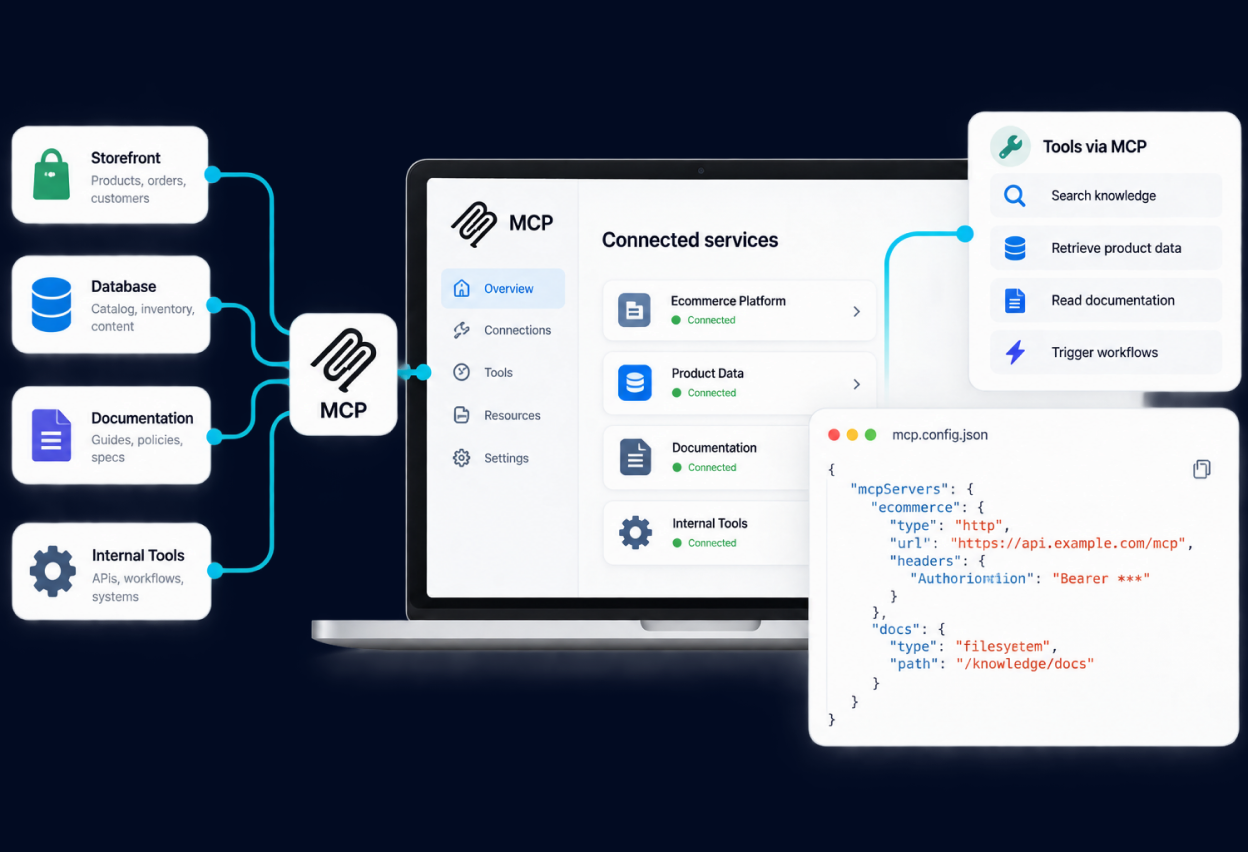
MCP lets a server expose tools, resources, and prompts through a common protocol so more than one compatible AI host can use the same defined capabilities. The current protocol is designed around interoperable client-server behavior rather than a separate custom contract for every AI application.
That does not mean every integration should become MCP. AI Consulting & Enablement can help compare MCP with a native connector, direct API integration, or conventional automation based on the actual hosts, systems, users, and actions involved.
Keep Protocol Compatibility Separate From Business Authorization
MCP defines how clients and servers exchange capabilities and requests. For remote connections, current authorization patterns align with OAuth-style protected-resource metadata and bearer-token validation, but the protocol does not decide which business roles should see data or invoke a tool.
Treat the server as a trust boundary. API Integrations and AI Agents & Automation can help map the underlying identities, scopes, source-system permissions, validation, approval points, and side effects before capabilities are exposed to an AI host.
Design the Server Around Clear MCP Capabilities
The server should expose only the protocol features the use case needs and keep each capability understandable to the host, model, and operating team.

1
Tools and Actions
Tools let an AI application invoke defined actions. Names, descriptions, input schemas, outputs, and side effects should be specific enough that a model can select the right capability without granting broader access than the workflow requires. Custom Development can support purpose-built MCP server logic where an existing system has no suitable interface.
2
Resources and Prompts
Resources provide retrievable context, while prompts provide reusable interaction patterns. Use them when the job is to supply information or a consistent prompt rather than perform an external action.
3
Remote and Local Transports
Current remote MCP uses Streamable HTTP with a stateless protocol core, while local child-process connections can use stdio. Legacy HTTP+SSE is deprecated, so production compatibility should be checked against the hosts and SDK versions expected in use.
4
Extensions and Host Capabilities
MCP now has an extension framework for capabilities beyond the core protocol, including Tasks for long-running work and MCP Apps for server-provided interactive UI. Extensions should be adopted only when the host and server both support the required behavior.
Operate MCP as a Versioned Security Boundary
Production reliability depends on the server, the connected host, and the underlying systems remaining aligned as protocol versions, schemas, credentials, and business rules change.
1
Read and Write Scope
Separate retrieval from actions that create, update, send, delete, charge, approve, or otherwise produce side effects. A read-only use case should not inherit write-capable tools simply because the server can expose them.
2
Identity, Tokens, and Permissions
Remote servers should validate tokens for the intended resource and apply the scopes and permissions required by the underlying system. Client or server self-description metadata should not be treated as a security identity.
3
Confirmation and Multi-Step Actions
Current MCP supports multi-round-trip requests so a tool can request additional input or confirmation during a call. Use that pattern for missing information or user confirmation, while keeping consequential business approvals explicit in the application workflow.
4
Diagnostics and Ongoing Ownership
Bug Fixes & Diagnostics and Ongoing Maintenance can support failures caused by schema changes, authorization issues, incompatible protocol versions, changed tools, or upstream system behavior after launch.

Model Context Protocol (MCP) FAQs
Model Context Protocol is an open standard for connecting compatible AI applications to external tools and data. An MCP server can expose tools, resources, and prompts, while a compatible host connects to those capabilities for use by an AI model.
No. An MCP server often sits in front of an API, database, application, or custom service and gives AI clients a standardized way to use selected capabilities. The underlying system still needs an interface, authentication model, data rules, and technical ownership.
Yes, when those hosts support the protocol version and capabilities the server uses. Portability is one of MCP’s strengths, but host-specific authorization, UI support, extensions, and approval behavior still need verification.
No. MCP standardizes the connection pattern, but security still depends on server design, authentication, token validation, permissions, transport, source-system controls, tool definitions, and how the AI host handles approval and execution.
MCP-based connections can be included within approved API integration, custom development, or AI-agent work when the use case and technical environment support them. The exact server, host, authorization, deployment, and security requirements need technical review before implementation is committed.

 USA
 Philippines


