















































Email, SMS, CRM & Customer Engagement
The customer engagement stack should follow the relationship the business is trying to manage, not the number of channels a vendor can offer. Always Open Commerce helps define which systems should own customer data, messaging, CRM activity, service interactions, and the connections between them.

Choose by Customer Journey and Platform Role
The seven platforms overlap in places, but they do not solve the same operating problem. Start with the customer journey, the data each team needs, and the role the platform should own before comparing feature breadth.

Klaviyo
A strong option to evaluate when a B2C team wants shared customer profiles to support lifecycle marketing, service context, analytics, and multiple messaging channels from one platform.

Mailchimp
For teams centered on email campaigns, audience management, automation, and SMS, Mailchimp provides a broad marketing environment without requiring the stack to become a full sales-and-service CRM.

HubSpot
Longer buying cycles, lead capture, B2B or sales-assisted journeys, and shared context across marketing, sales, and service are the situations where HubSpot deserves a closer look.

Omnisend
Ecommerce-first teams can evaluate Omnisend when store behavior needs to drive automations across email, SMS, and web push without separate channel builders.

Dotdigital
Multiple stores, brands, regions, or customer-data sources can make Dotdigital relevant when cross-channel marketing needs a stronger operating structure.

Attentive
Customer recognition and mobile messaging are central to Attentive, with SMS, email, RCS, and push coordinated around shared shopper identity.

Tidio
When the primary problem is shopper questions and customer support rather than lifecycle marketing, Tidio brings live chat, AI-assisted service, structured automation, and product guidance into the storefront conversation.
Evaluate Customer Data, Lifecycle Coverage, and System Ownership
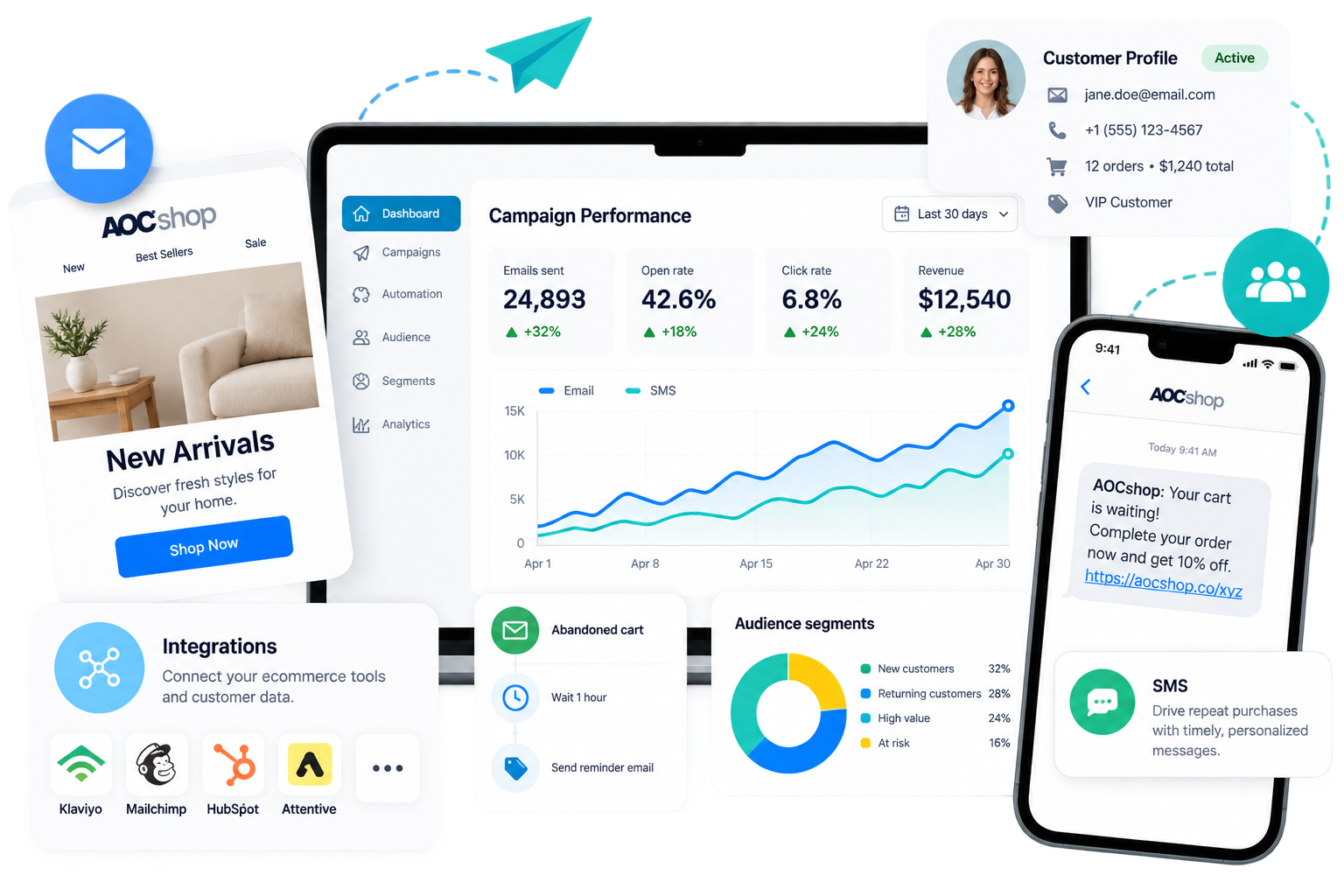
A customer-engagement stack should be evaluated around the information each platform needs, the lifecycle moments and channels it is responsible for, how customer identity moves between systems, and which team or platform owns each workflow after implementation.
Customer Data & Identity
Define which customer records, events, segments, and identifiers each platform needs and which system should own the underlying information used across marketing and customer communication.
Channel & Lifecycle Requirements
Map the email, SMS, CRM, service, and other customer interactions the business actually needs before selecting tools based on feature breadth alone.
System Ownership, Integrations & Team Workflow
Define which platform owns each customer record, channel, workflow, and operational responsibility, how the systems exchange information, and which teams need specialist support to manage the stack over time.
Coordinate the Customer Engagement Stack
Once the platform roles are clear, Always Open Commerce can coordinate approved work across lifecycle messaging, storefront journeys, customer data, and connected systems without assuming every vendor capability belongs in scope.
Build Lifecycle Messaging Around Customer Data
Use Email Marketing to structure campaigns and lifecycle journeys around the customer information, audience logic, timing, and message purpose the program actually needs.
Coordinate SMS With the Broader Journey
Use SMS Marketing where the channel has a defined role alongside email, storefront behavior, and other customer touchpoints, with legal or consent questions routed to the appropriate specialist.
Connect Customer Systems and Events
Use API Integrations when approved customer, order, product, or event data needs to move between the storefront, CRM, marketing, service, or operational systems. Exact feasibility requires technical review.
Improve the Storefront Around Engagement
Use Conversion Rate Optimization and Cart Recovery where customer-journey or storefront friction affects how messaging, recovery, and on-site experiences work together.

Frequently Asked Questions
Start with the customer journeys, data, channels, and team responsibilities the stack must support. Platform roles should be defined before feature lists are compared.
Yes. Work can include lifecycle strategy, storefront improvements, integrations, data-flow troubleshooting, campaign implementation, and ongoing optimization within an approved project scope.
Not necessarily. Some businesses benefit from a broader platform, while others need connected specialist tools. The right model depends on ownership, data flow, operating complexity, and the experiences being managed.
Customer data should move according to clearly defined system ownership, required events and identifiers, consent rules, and the workflows each platform must support. Exact integration feasibility requires technical review.

 USA
USA
 Philippines


