






















































Performance Audits
When revenue, conversion, traffic, search, or paid performance changes, the first dashboard rarely explains the full story. Always Open Commerce compares ecommerce, analytics, search, media, funnel, and technical evidence to narrow what changed and what deserves investigation next.


Define What Changed Before Choosing a Fix
Revenue, conversion rate, traffic, search visibility, and campaign metrics can change at the same time without sharing the same cause. A useful audit starts with the business question and the evidence needed to answer it.
The goal is to narrow the problem before committing budget or development time to a fix. Recent merchandising, campaign, product, traffic, measurement, and technical changes are considered when relevant to that question.
Review Store, Traffic, Search, Media & Funnel Signals
Always Open Commerce reviews the evidence domains that can explain the change, then compares them in business context rather than forcing every audit through the same dashboard.

Revenue & Conversion
Review orders, revenue, conversion rate, average order value, customer behavior, and product mix where relevant. These outcomes establish what changed commercially before deeper channel or site analysis begins.

Traffic & Channel Mix
Compare acquisition mix, new and returning traffic, device, geography, landing patterns, and material volume changes. A blended metric can move simply because the mix of visitors or destinations changed.

Search Visibility
Review relevant search-performance signals such as clicks, impressions, queries, and landing visibility alongside known site changes. Deeper organic-search diagnosis or implementation can move to SEO when appropriate.

Paid Media
Review spend, conversion signals, acquisition cost, campaign changes, and landing alignment in the account’s measurement context. Deeper campaign work can move to Google Ads or Meta Ads when the evidence points there.

Funnel & Landing Experience
Compare product discovery, cart, checkout, lead, and other important steps to see where behavior changed. Conversion Rate Optimization can investigate experience friction when the audit identifies the funnel as the likely constraint.

Technical Context
Bring in tracking, speed, app, integration, checkout, or platform findings when they can explain the business question. Technical Audits can own deeper code- or system-level diagnosis when needed.
Reconcile Data Sources Before Assigning Cause
Ecommerce platforms, analytics, advertising systems, and search tools measure different parts of the journey. Differences in attribution, timing, aggregation, privacy, or implementation can create conflicting numbers without proving that one source is wrong.

Can the Measurement Be Trusted?
Tracking gaps, consent behavior, checkout events, UTMs, channel grouping, or attribution settings can change the reported story. Material discrepancies should be investigated before a performance cause is assigned.
Is the Change Local or Broad?
Compare relevant segments such as channel, device, market, landing area, product group, customer type, and time period. This helps show whether the change is concentrated in one area or appears across the business.
What Is Confirmed Versus Still a Hypothesis?
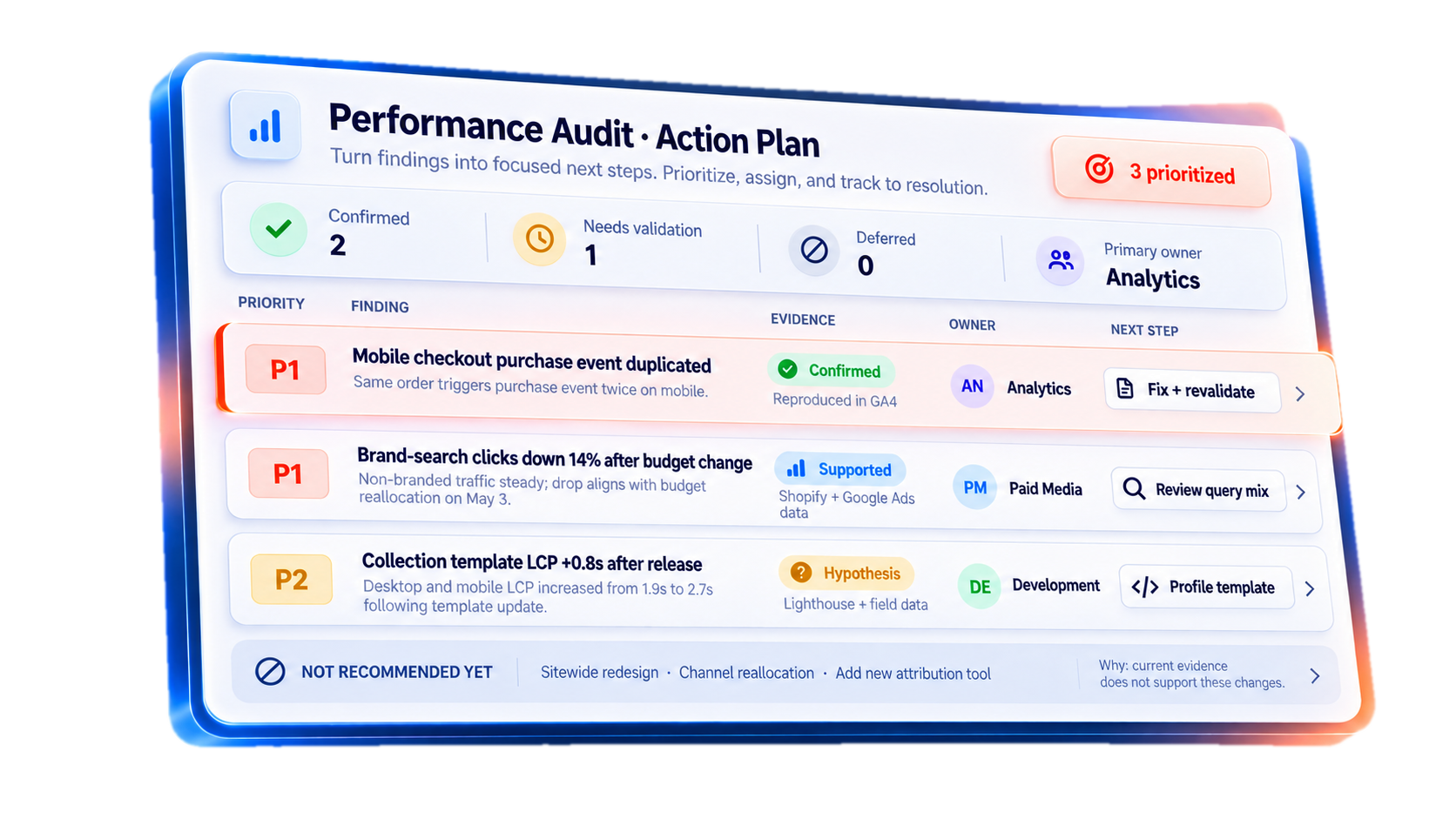
Separate observations, supported conclusions, hypotheses, and missing evidence. A useful audit makes uncertainty visible so the business knows what can be acted on now and what still needs validation.

Turn Findings Into a Prioritized Action Plan
The audit should leave the business with a shorter decision list: what changed, what the evidence supports, what remains uncertain, what deserves action, and which specialist or team should own the next step.
Always Open Commerce can route supported findings into SEO, Google Ads, Meta Ads, Technical Audits, Conversion Rate Optimization, Content Writing & Strategy, or other specialist work when implementation is separately in scope.
A performance audit does not automatically include implementing every recommendation, and it does not guarantee that a recommended change will improve results. Its job is to improve the quality and order of the next decisions.
Choose an Audit

Review technical SEO issues, keyword opportunities, and content gaps to identify search visibility constraints and prioritize recommendations for further action.

Review campaign structure, targeting, spend, and conversion tracking to identify issues and prioritize recommendations, including landing-page alignment where scoped.

Review storefront usability, navigation, and purchase journeys to identify conversion friction and prioritize recommendations for improving the customer experience.
Frequently Asked Questions
Depending on the business question, an audit can review store performance, traffic mix, search visibility, paid-media signals, funnel behavior, measurement quality, and relevant technical context. The scope follows the question rather than requiring every source every time.
It can identify supported findings and narrow likely causes when enough evidence exists. Conversion-rate changes should be read alongside traffic mix, product mix, site experience, promotions, inventory, measurement, and recent changes before a cause is assigned.
No. Outcomes depend on the site, market, traffic, product, offer, implementation, and platform behavior. Always Open Commerce does not guarantee revenue, traffic, conversion, ROAS, or other performance outcomes.

 USA
USA
 Philippines


