
























































Structured Data
Structured data should describe the storefront that actually exists. Always Open Commerce audits, implements, and cleans up ecommerce markup around products, offers, organization details, navigation, supported search features, and the platform or code responsible for keeping that information current.

Structured Data Must Match the Storefront
Structured data gives machines a clearer representation of information already present on the site. For ecommerce, that can include products, offers, organization details, reviews, navigation, and other relationships supported by the destination.
More markup is not automatically better. The implementation should match visible content, current platform requirements, and the way price, availability, product details, and site structure are actually maintained.
Product, Offer & Site Markup
Always Open Commerce reviews existing markup and its generators before deciding what should be added, corrected, consolidated, or removed.

Product & Offer Markup
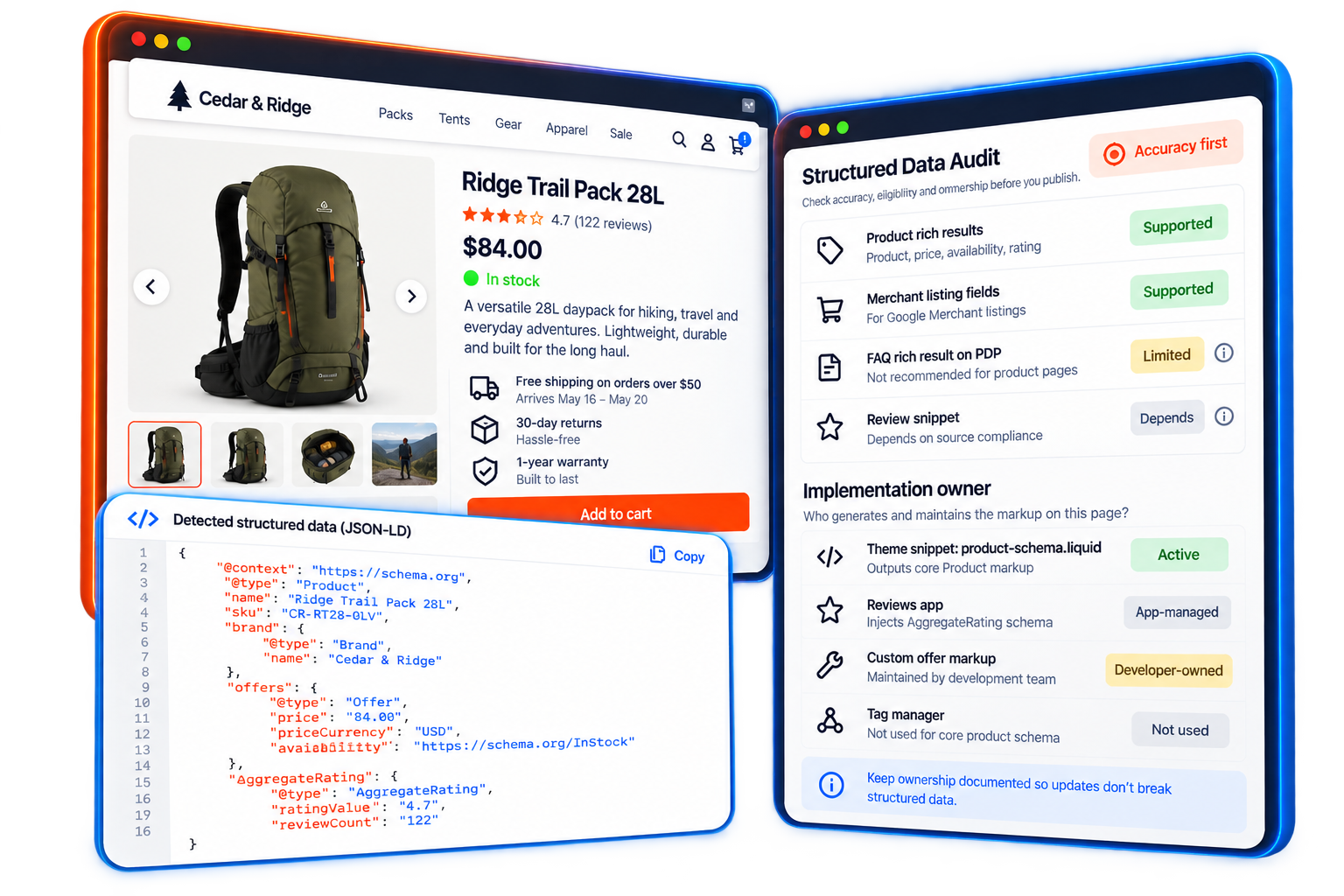
Represent supported product identity, offers, price, availability, variants, shipping, returns, reviews, and other eligible information when the storefront and underlying commerce data can support it accurately.

Organization & Site Context
Represent supported business and site-level information consistently where it helps systems connect the organization to the site. Structured data should describe real facts and policies rather than create claims the business does not make elsewhere.

Breadcrumb & Page Relationships
Mark up real navigation and hierarchy so machine-readable relationships reinforce the site’s information architecture. Do not create artificial page relationships solely for schema.

Markup Cleanup & Validation
Themes, apps, plugins, tag managers, and custom code can create overlapping or outdated markup. Identify the generators, remove or correct supported conflicts, and validate the resulting implementation against visible content and current platform requirements.
Check Accuracy, Eligibility & Ownership First
The difficult part is often not the syntax. It is deciding which system owns the fact, whether the intended search feature is currently supported, and which platform component or technical owner should generate the markup.

Does the Markup Match Visible Content?
Price, availability, ratings, review counts, shipping, returns, organization details, and other statements should be accurate and reconcilable with what users can see. Markup is not a substitute for missing storefront information.
Is the Intended Feature Currently Supported?
Schema.org provides a broad vocabulary, while search platforms support selected types, properties, and experiences. Implementation should follow current first-party documentation for the intended use rather than relying on schema examples alone.
Who Generates and Maintains the Markup?
Confirm whether the theme, app, plugin, template, tag manager, platform setting, or custom code owns the implementation. Code-level changes may require Custom Development or another technical scope before the markup can be changed safely.
Use Structured Data as Infrastructure, Not a Promise
Accurate structured data can help search and other systems understand ecommerce information and can make eligible content available for supported enhanced experiences. It does not force a search engine to display a rich result or provide a particular ranking.
Always Open Commerce can coordinate structured-data work with SEO, Shopping Feeds, AI Search & GEO, and Custom Development when the same product and business information needs to stay consistent across content, feeds, markup, and code.
The standard is accuracy and maintainability. Markup should remain aligned as routine catalog and site changes occur, without promising rich results, rankings, AI citations, traffic, or revenue.
Search & Product Data


Frequently Asked Questions
Structured data is machine-readable information, commonly expressed with Schema.org vocabulary, that describes entities, properties, and relationships on a site. For ecommerce, that can include products, offers, organization details, breadcrumbs, reviews, and other supported information.
No. Schema.org provides a broad vocabulary. Search platforms decide which types and properties they support for specific experiences, so implementation should follow both the vocabulary and current first-party platform requirements.
No. Correct markup can make eligible content available for supported search features, but the search engine decides whether an enhanced result is shown. Always Open Commerce does not guarantee rich results, rankings, traffic, or AI visibility.
Sometimes. If markup is generated by a theme, app, plugin, template, tag manager, or custom code, a technical specialist may need to change the implementation. Feasibility is confirmed before code-level work is committed.

 USA
 Philippines


